

See The Mark Is Real - And its Coming!
The United States is moving toward clearer rules for digital assets while China, India, Europe and dozens of central banks develop new forms of programmable or sovereign digital money. None of these systems is automatically the Mark of the Beast. Together, however, they show that individualized, rapid and far-reaching control of commerce is now technologically plausible.
A financial headline—and an ancient warning
On September 10, CNBC reported that Coinbase CEO Brian Armstrong expected the United States to reach greater regulatory clarity for crypto whether or not the Senate passed the CLARITY Act in its present form. The immediate story is financial and legal. For Bible readers, it also raises a larger question: what kind of infrastructure would be required for the economic restrictions described in Revelation 13?
The responsible answer begins with restraint. The CLARITY Act is not the Mark of the Beast. Bitcoin is not the Mark. A central-bank digital currency is not automatically the Mark. Yet the world is building increasingly connected systems of digital money, digital identity, instant authorization and enforceable financial rules. That convergence deserves careful attention.

What the CLARITY Act would do
The Digital Asset Market Clarity Act of 2025, H.R. 3633, is a market-structure bill. It seeks to divide federal oversight of digital assets between the Securities and Exchange Commission and the Commodity Futures Trading Commission, define categories of digital assets, establish registration pathways and create disclosure and customer-protection requirements.
The House passed the bill 294–134 on July 17, 2025. It then moved into the Senate process, where lawmakers, banks and crypto companies continued debating stablecoin rewards, decentralized finance, ethics provisions and the boundaries of regulatory authority. The important point is not that Congress secretly created a digital dollar. It did not. The point is that digital assets are moving deeper into mainstream, regulated finance.
America is not creating a CBDC through CLARITY
A central-bank digital currency is a direct digital liability of a central bank. Bitcoin, privately issued stablecoins, tokenized securities and other crypto assets have different architectures. The CLARITY Act addresses digital-asset market structure; it does not create a Federal Reserve retail CBDC.
In January 2025, the White House issued an executive order opposing the establishment, issuance or circulation of a U.S. CBDC. Congress separately enacted the GENIUS Act in July 2025 to regulate payment stablecoins, and federal agencies have continued clarifying how existing securities and commodities laws apply to crypto assets. Different mechanisms are developing, but the larger transformation is the same: money is becoming software.
Revelation describes economic permission
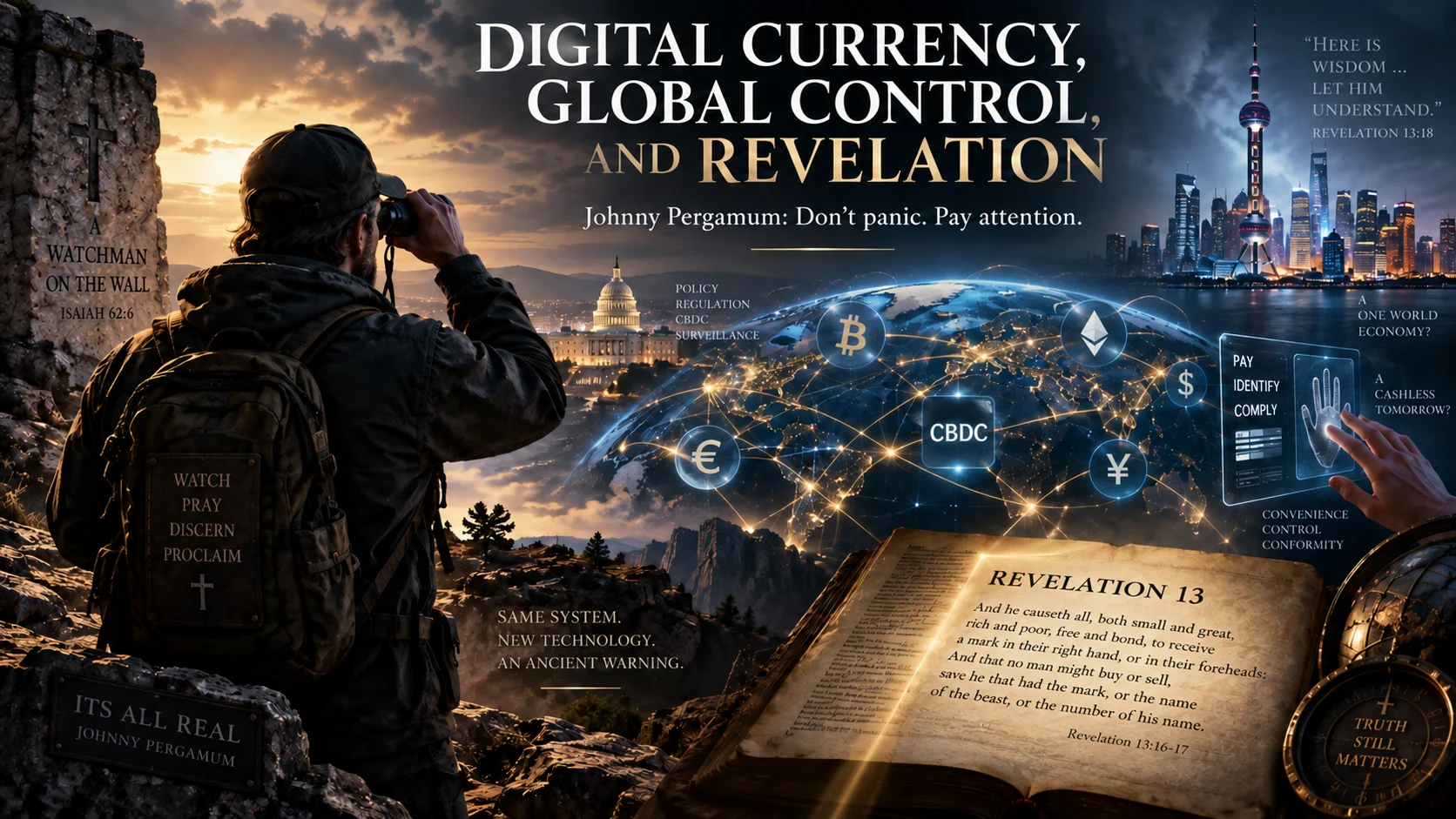
Revelation 13:16–17 says the mark reaches small and great, rich and poor, free and bond, and that no person may buy or sell without it. The prophecy therefore describes more than an unusual object. It describes permission to participate in commerce—an authority able to identify a person, determine authorization and enforce exclusion.
For most of history, enforcing that condition across the world would have been extraordinarily difficult. People could barter, use coins, trade metals and operate in distant markets. Today identities can be verified digitally, payments authorized in milliseconds, sanctions applied electronically, transactions analyzed by artificial intelligence and biometrics used to confirm faces, fingerprints or irises. That does not prove fulfillment, but it makes the described mechanism technologically plausible.
China: the digital yuan is already real
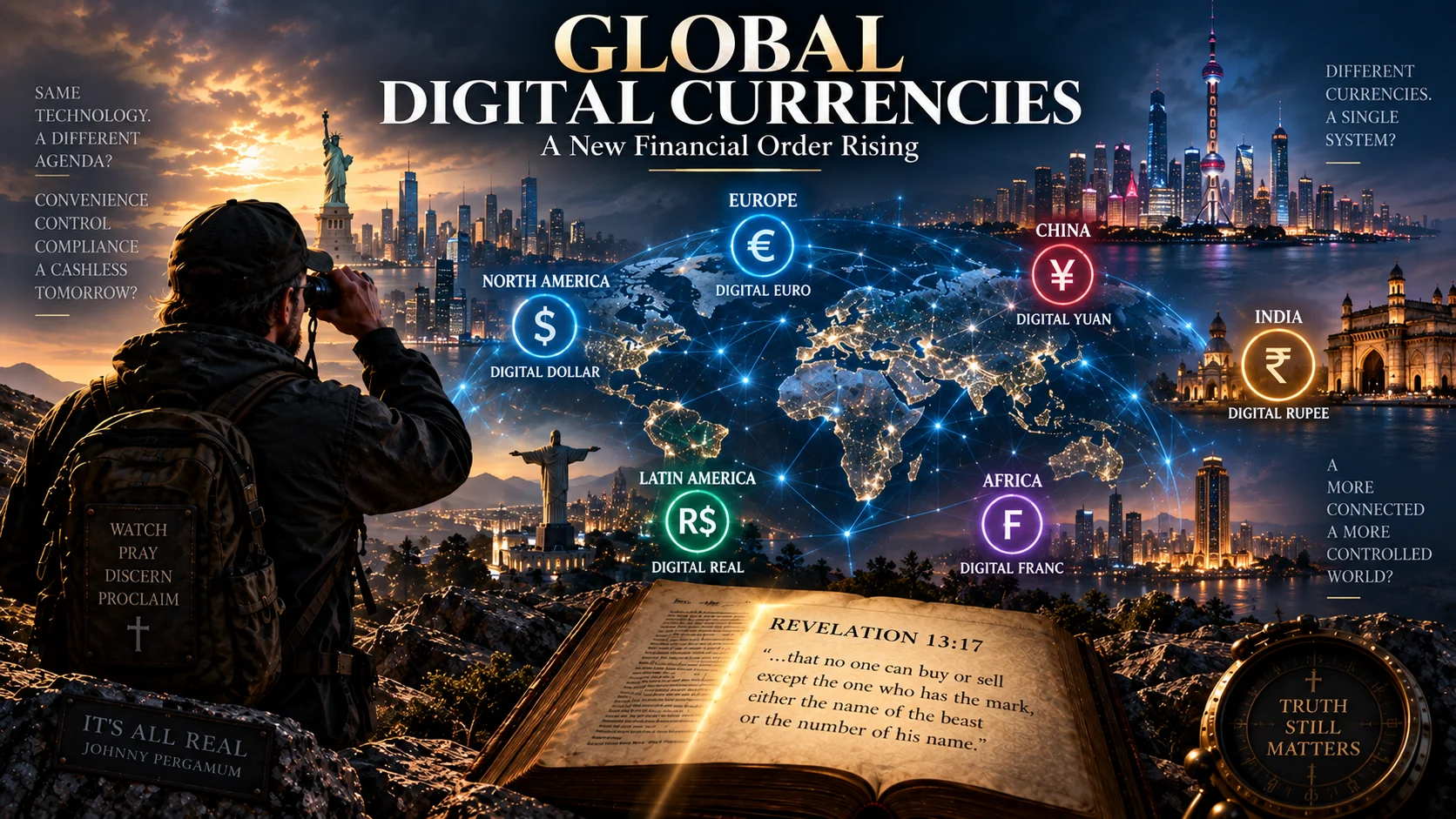
China's e-CNY is sovereign currency issued digitally by the People's Bank of China—not Bitcoin and not a decentralized token. China has expanded trials into government spending, prepaid cards, electricity payments, smart-contract experiments and cross-border use.
Bank of China announced cross-border retail e-CNY activity through infrastructure connecting Hong Kong, Macao, Singapore, Laos and Thailand. That does not make China the Beast, nor the e-CNY the Mark. It demonstrates that sovereign digital money is gaining practical capabilities across borders.
India: digital money becomes programmable
The Reserve Bank of India began its retail digital-rupee pilot in December 2022. RBI describes it as the digital form of physical currency, held in a wallet and used for person-to-person and merchant payments.
India has also explored welfare payments whose use can be directed toward intended purposes and cross-border arrangements with partners such as Singapore and the United Arab Emirates. Programmability can reduce paperwork and improve delivery, but capability remains capability: money that can interact with conditions can do things physical cash cannot.
Europe: a digital euro with explicit safeguards
The European Central Bank says a digital euro could potentially be issued in 2029 if the necessary legislation is adopted. Its stated design includes important safeguards: the ECB says the currency itself would not be programmable to restrict where, when or to whom a person may pay, and that it would complement rather than replace cash.
Honest analysis must include those facts. It would be false to claim Europe has created the Mark. What can be said is that another major economic bloc is developing sophisticated public digital-payment infrastructure, while the ultimate laws, governance and technical connections remain matters of public choice.
This is bigger than three countries
The Bank for International Settlements reported that 85 of 93 surveyed central banks were exploring a retail CBDC, wholesale CBDC or both. Exploration is not launch, and most have not issued a general-purpose CBDC. Still, the direction is global.
Live sovereign digital currencies already include Nigeria's eNaira, the Bahamas' Sand Dollar and Jamaica's JAM-DEX. The serious questions are no longer whether sovereign digital currencies exist, but how broadly they will be adopted, what protections govern them and whether different systems will eventually become interoperable.
The Bible's warning is about a system
Christians can become distracted trying to identify one object—a microchip, QR code, smartphone, CBDC, cryptocurrency or biometric implant. Revelation describes something larger: political authority, religious allegiance, identity and commerce converging in one system.
The exact phrase ‘one-world government’ does not appear in Revelation. Many futurist Christians draw the idea from passages such as Revelation 17:13, where kings give their power and strength to the beast, and Daniel 7:23, which describes a kingdom that devours the whole earth. Other Christian traditions interpret these passages differently. The narrower point is clear: Revelation portrays political and economic authority operating on an extraordinary international scale.
Is this fearmongering?
There are legitimate benefits to digital finance. Faster settlement can lower costs. Digital identity can reduce fraud. Conditional payments can automate contracts. CBDCs may reach people underserved by banks. Christians do not need to deny those benefits or exaggerate every development.
The harder question is how economic exclusion could become universal, instantaneous and enforceable against ordinary people across enormous distances. That problem looks different in 2026 than it did in A.D. 90 because identity, accounts, credentials, payments and communication are increasingly digital.
The development to watch is convergence
Do not focus on one technology. Watch digital money, stablecoins, CBDCs, tokenized assets, digital identity, biometrics, artificial intelligence, instant payments, smart contracts, sanctions, regulation and international settlement networks.
Combined, those tools can identify who is attempting a transaction, which account they control, whether they are authorized, whether a transaction satisfies programmed rules and whether it should proceed—then approve or reject it almost instantly. Your Visa card is not the Mark. But the infrastructure needed to enforce Revelation's economic language no longer sounds like science fiction.
Bitcoin could work against centralized control
Decentralized cryptocurrency complicates simplistic claims. Bitcoin has no central issuer, and a person controlling private keys can transact without asking a central bank for permission. Calling all crypto the Mark therefore makes little sense.
The future may contain competing centralized digital currencies, regulated stablecoins, decentralized cryptocurrencies, tokenized securities, conventional bank deposits and physical cash. Which systems dominate, survive, interoperate or become restricted remains unknown.
The Mark is more than technology
Revelation 14:9 connects the Mark with worship and allegiance. The final system portrayed in Revelation is not merely financial technology that became efficient; it is political, economic and spiritual rebellion against God.
Christians have labeled barcodes, credit cards, phones and many other inventions as the Mark. Failed declarations teach people to stop listening. We do not need sensationalism. Scripture is dramatic enough.
What should we watch?
Watch whether commerce becomes more completely digital; whether identity and payment become tightly connected; whether national systems become interoperable; whether governments gain the ability to condition financial access; whether geopolitical authority consolidates; and whether people exchange autonomy for convenience, security or stability.
Do not set dates. Jesus said no person knows the day or hour, yet He repeatedly told His followers to watch. Those commands belong together: do not panic, do not pretend certainty, and do pay attention.
Could the world of Revelation 13 actually exist?
A generation ago, worldwide individualized control of commerce could sound technologically unrealistic. Today the primary obstacles are political, legal, cultural, economic and spiritual—not technical.
Institutions come first. Habits come first. Convenience comes first. Then a future ruler could use what already exists. No one can responsibly say whether Revelation 13 will be fulfilled in five years, ten years or fifty. What can be documented is that humanity now possesses infrastructure remarkably compatible with its economic mechanism.
Don't take my word for it
Read the legislation, government documents, central-bank reports and history. Then read Revelation 13, Daniel 7 and Revelation 17. Ask whether their descriptions are more technologically plausible today than fifty years ago.
The Mark is not the central message of Revelation—Jesus Christ is. Revelation does not end with the Beast winning; it ends with Christ reigning. Watch the CLARITY Act, digital yuan, digital rupee, digital euro, stablecoins, digital identity, cash and international financial networks. Fear is not the assignment. Discernment is.
Pay attention
The Mark is not here simply because money is becoming digital. The CLARITY Act is not the Mark. Bitcoin is not the Mark. A CBDC is not automatically the Mark.
But Revelation predicts a future system capable of determining who may buy and sell. For the first time in history, humanity possesses technology capable of enforcing such a system globally, rapidly and at the individual level. That is the story: not panic, but preparation, discernment and investigation. Read. Investigate. Pray. Watch.
Sources & further reading
- CNBC: Coinbase CEO expects U.S. regulatory clarity regardless of CLARITY Act vote
- U.S. House Clerk: CLARITY Act passed 294–134
- Congress.gov: H.R. 3633 committee report
- SEC: Application of federal securities laws to crypto assets
- White House: Strengthening American leadership in digital financial technology
- White House: GENIUS Act signed into law
- Bank of China: Cross-border retail e-CNY transactions
- Reserve Bank of India: Digital rupee FAQ
- European Central Bank: The digital euro
- European Central Bank: Digital euro FAQ
- BIS: Results of the 2024 CBDC survey
- Central Bank of Nigeria: eNaira
- Central Bank of The Bahamas: Sand Dollar
- Bank of Jamaica: JAM-DEX
Editorial note: Documented news and measurements above are linked to their sources. Prophetic interpretation is commentary, not a claim that a specific future date or fulfillment can be proven from a headline.
← Back to all posts