FAITH THAT ISN’T AFRAID OF FACTSStudy the creation.
Study the creation.
Follow the evidence.
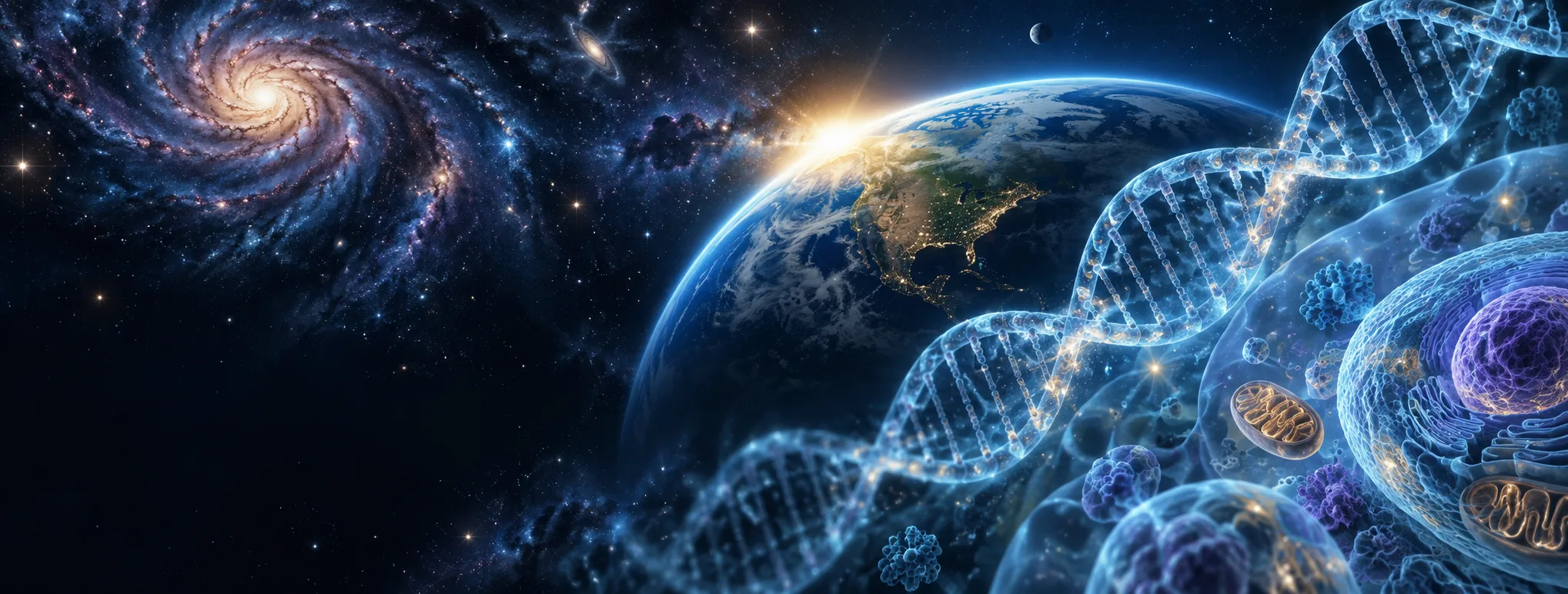
From the history of the universe to the instructions inside a cell, science reveals a world of astonishing order, depth, and beauty.
“The heavens declare the glory of God; and the firmament sheweth his handywork.”
Psalm 19:1 (KJV)
Our position: science measures the natural world; Scripture reveals its Creator, purpose, and moral meaning. Scientific observations can support and enrich a Christian worldview, but slogans are not evidence and God is not a laboratory variable.
THE BIG QUESTIONSScience explains mechanisms.
Science explains mechanisms.
Faith asks why anything exists.
A telescope can measure redshift. A sequencer can read DNA. Neither instrument can decide whether reality has purpose, why rational laws exist, or what human beings ought to do. Those are philosophical and theological questions informed—but not replaced—by discovery.
Why is nature intelligible? Why do laws remain stable? Why does consciousness exist? Why do persons have dignity?
12 WINDOWS INTO CREATION
What we observe—and what it means
Every card separates the measured observation from our Christian reflection. Open the source to examine the evidence yourself.
A universe with a measurable beginning
13.8 billion years
WHAT SCIENCE ESTABLISHES
Expansion, the cosmic microwave background, and light-element abundance support a universe that developed from an extraordinarily hot, dense early state.
CHRISTIAN REFLECTION
Genesis opens with a universe that is not eternal or self-existent. Christians see the measured history of the cosmos as consonant with creation, while recognizing that Genesis and cosmology answer different kinds of questions.
Stable laws make discovery possible
4 fundamental forces
WHAT SCIENCE ESTABLISHES
Gravity, electromagnetism, and the strong and weak nuclear interactions behave consistently enough for stars, chemistry, planets, and scientific prediction to exist.
CHRISTIAN REFLECTION
Scripture presents creation as ordered and upheld rather than capricious. The laws do not mathematically prove their Lawgiver, but their regularity is precisely what makes experimental science possible.
Earth occupies a life-permitting neighborhood
Liquid surface water
WHAT SCIENCE ESTABLISHES
NASA defines a stellar habitable zone as the region where surface temperatures could permit liquid water. Distance alone is not enough; atmosphere, size, and stellar stability also matter.
CHRISTIAN REFLECTION
Christians may receive Earth’s layered habitability with gratitude and wonder. This is an argument about cumulative fitness for life—not a claim that one “Goldilocks” measurement proves God.
Water continually circulates through the planet
3 natural states
WHAT SCIENCE ESTABLISHES
Solar energy drives evaporation; vapor condenses into clouds; precipitation, runoff, groundwater, ice, and transpiration return water through a complex planetary cycle.
CHRISTIAN REFLECTION
Ecclesiastes and Job poetically observe water returning, rising, and raining. They are not modern hydrology textbooks, but they attend accurately to the recurring natural world.
Life stores and reads biological instructions
≈3 billion DNA bases
WHAT SCIENCE ESTABLISHES
A human genome contains about three billion nucleotide bases and roughly 20,000 genes. Cells copy DNA into RNA, and ribosomes read that sequence to assemble proteins.
CHRISTIAN REFLECTION
The language of code is scientifically useful; the inference of an ultimate Mind is philosophical. For believers, this information-rich chemistry deepens the force of “fearfully and wonderfully made.”
One genome supports many specialized cells
Thousands of cell states
WHAT SCIENCE ESTABLISHES
Muscle, bone, and brain cells contain essentially the same DNA. Chemical marks and regulatory proteins help determine which genes are active and how each cell uses its instructions.
CHRISTIAN REFLECTION
A body composed of distinct yet coordinated members is both biological reality and one of Paul’s richest pictures of the church: difference serving unity.
Humanity is one closely related family
≈0.4% variable DNA
WHAT SCIENCE ESTABLISHES
NHGRI estimates that the variable portion of a human genome is about 0.4%. Our visible differences are real, yet all people share overwhelmingly similar biology.
CHRISTIAN REFLECTION
That biological unity sits naturally beside the Bible’s insistence that every person bears God’s image and that God “hath made of one blood all nations.” It leaves no room for racial superiority.
Cells run coordinated molecular systems
20,000+ protein-coding genes
WHAT SCIENCE ESTABLISHES
Membranes regulate exchange, ribosomes build proteins, mitochondria transform energy, and signaling networks coordinate activity. These are chemical processes, but their integration is breathtaking.
CHRISTIAN REFLECTION
Christians need not call every complex structure “unevolvable” to marvel at it. Mechanisms explain how a system operates without exhausting why a living, law-governed world exists.
The Cambrian records dramatic diversification
Beginning ≈541 million years ago
WHAT SCIENCE ESTABLISHES
The Cambrian fossil record preserves a remarkable expansion of animal forms, hard parts, feeding strategies, and ecosystems. By its end, nearly all living animal phyla had representatives.
CHRISTIAN REFLECTION
Christians differ over how the fossil sequence relates to Genesis. Everyone should describe the record accurately—including earlier Ediacaran life—then distinguish evidence from interpretation.
A dynamic Earth builds and recycles landscapes
7 major tectonic plates
WHAT SCIENCE ESTABLISHES
Mapped earthquakes, magnetic reversals, seafloor spreading, ocean trenches, and mountain belts established plate tectonics as the unifying framework of modern geology.
CHRISTIAN REFLECTION
The same processes that build spectacular landscapes can bring devastating earthquakes and eruptions. Biblical faith makes room for creation’s beauty, danger, groaning, and our duty to protect neighbors.
Life depends on networks, not isolated parts
Energy • water • nutrients
WHAT SCIENCE ESTABLISHES
Pollination, decomposition, food webs, soil communities, oceans, forests, and climate interact across scales. Damage to one relationship can cascade through an ecosystem.
CHRISTIAN REFLECTION
The biblical picture of creatures inhabiting a shared, provisioned world encourages stewardship rather than domination without restraint. Creation care is neighbor care.
Creation rewards honest investigation
Observe • test • revise
WHAT SCIENCE ESTABLISHES
Science advances by measurement, reproducibility, criticism, and willingness to revise models when evidence changes. Its claims remain answerable to the natural world.
CHRISTIAN REFLECTION
“Prove all things; hold fast that which is good” is not a lab protocol, but its posture—test claims, reject deception, keep truth—belongs on every evidence page.
THE LIBRARY IN EVERY CELL
DNA is only the beginning
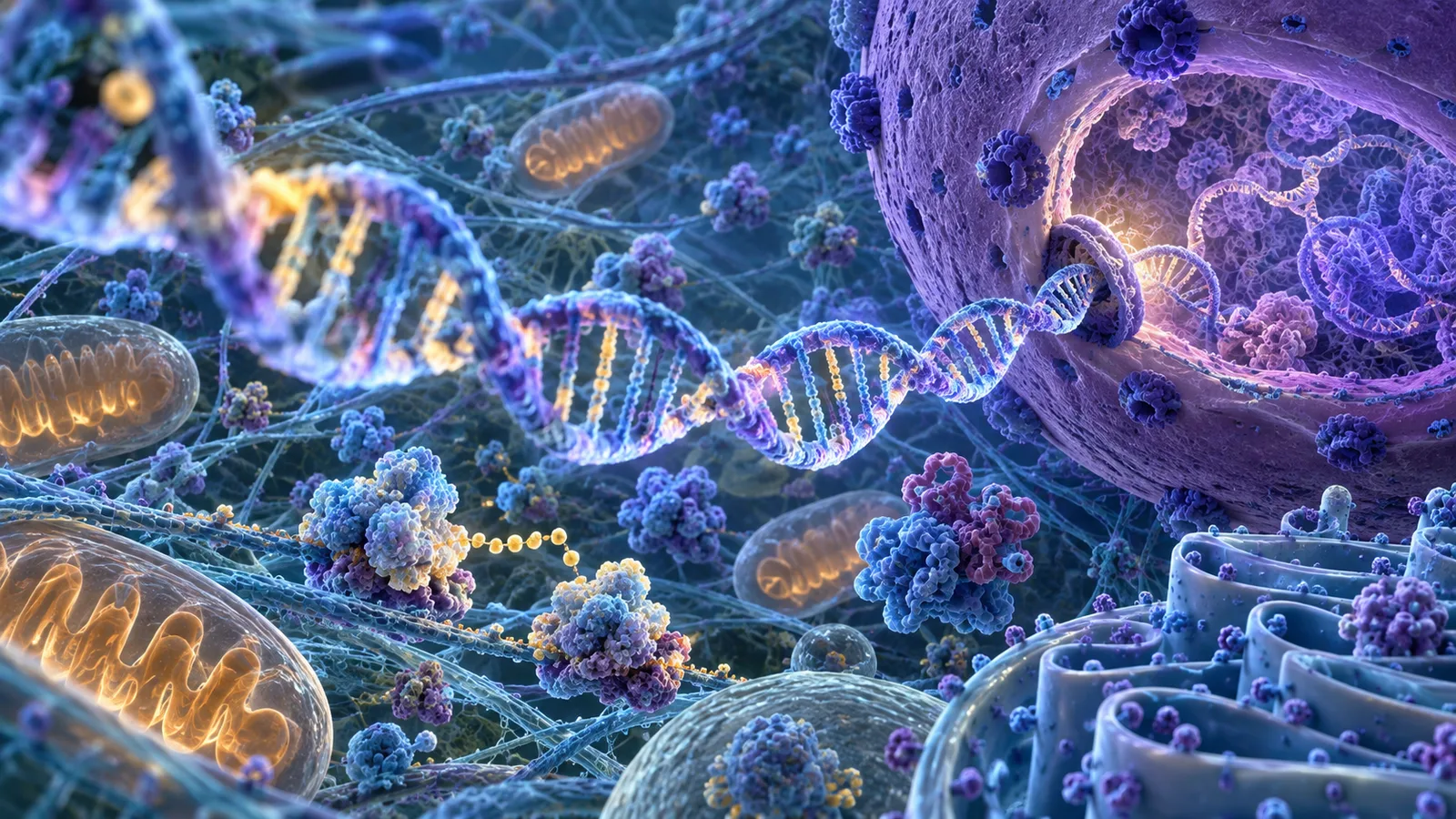
The genome is not simply a long string of letters. Cells copy selected regions, edit RNA, build and fold proteins, transport cargo, repair damage, respond to signals, and coordinate with neighboring cells.
- Storage: DNA preserves inherited sequence information.
- Expression: regulatory systems control where and when genes are read.
- Translation: ribosomes assemble amino acids into proteins.
- Coordination: signaling networks let cells respond and cooperate.
A LIVING PLANET
Habitability is a system, not a single lucky number
Liquid water, usable energy, chemistry, atmosphere, long-term climate, geological cycling, and ecological relationships work together. NASA’s search for habitable worlds begins with liquid water—but explicitly says many additional conditions are required.
“O Lord, how manifold are thy works! in wisdom hast thou made them all.” Psalm 104:24 (KJV)

EVIDENCE BEFORE SENSATIONALISM
Claims we will not overstate
Truth does not need a weak argument. We corrected several popular claims from the previous page because accuracy matters.
“Evolution violates the second law of thermodynamics.”
It does not. Earth is not a closed system; it continually receives solar energy. Entropy arguments must account for energy flows and total entropy.
“Complexity alone mathematically proves design.”
Complexity can motivate a design inference, but a probability is meaningless unless alternatives, assumptions, and selection processes are defined.
“The Cambrian animals had no predecessors.”
The diversification is remarkable, but Ediacaran organisms and earlier traces exist. The honest question concerns the pattern, tempo, causes, and interpretation.
“The Bible is a modern science textbook.”
Scripture’s purpose is theological and redemptive. It speaks truly about creation in ancient literary forms; responsible readers attend to genre and context.
A LONG TRADITION
Faith and scientific work are not enemies
Kepler studied planetary motion, Pascal mathematics and pressure, Boyle chemistry, Newton mechanics and gravitation, Faraday electromagnetism, Mendel heredity, and Maxwell field theory. Their beliefs were not identical, but each understood the study of nature within a world created and ordered by God.
Historical faith does not make every scientific idea correct—and achievement does not prove every theological claim. It does show that rigorous investigation and Christian belief have fruitfully coexisted for centuries.
KeplerPascalBoyleNewtonFaradayMendelMaxwell
Wonder is the beginning—not the end—of inquiry.
Keep asking. Check the source. Follow the evidence wherever it leads.