
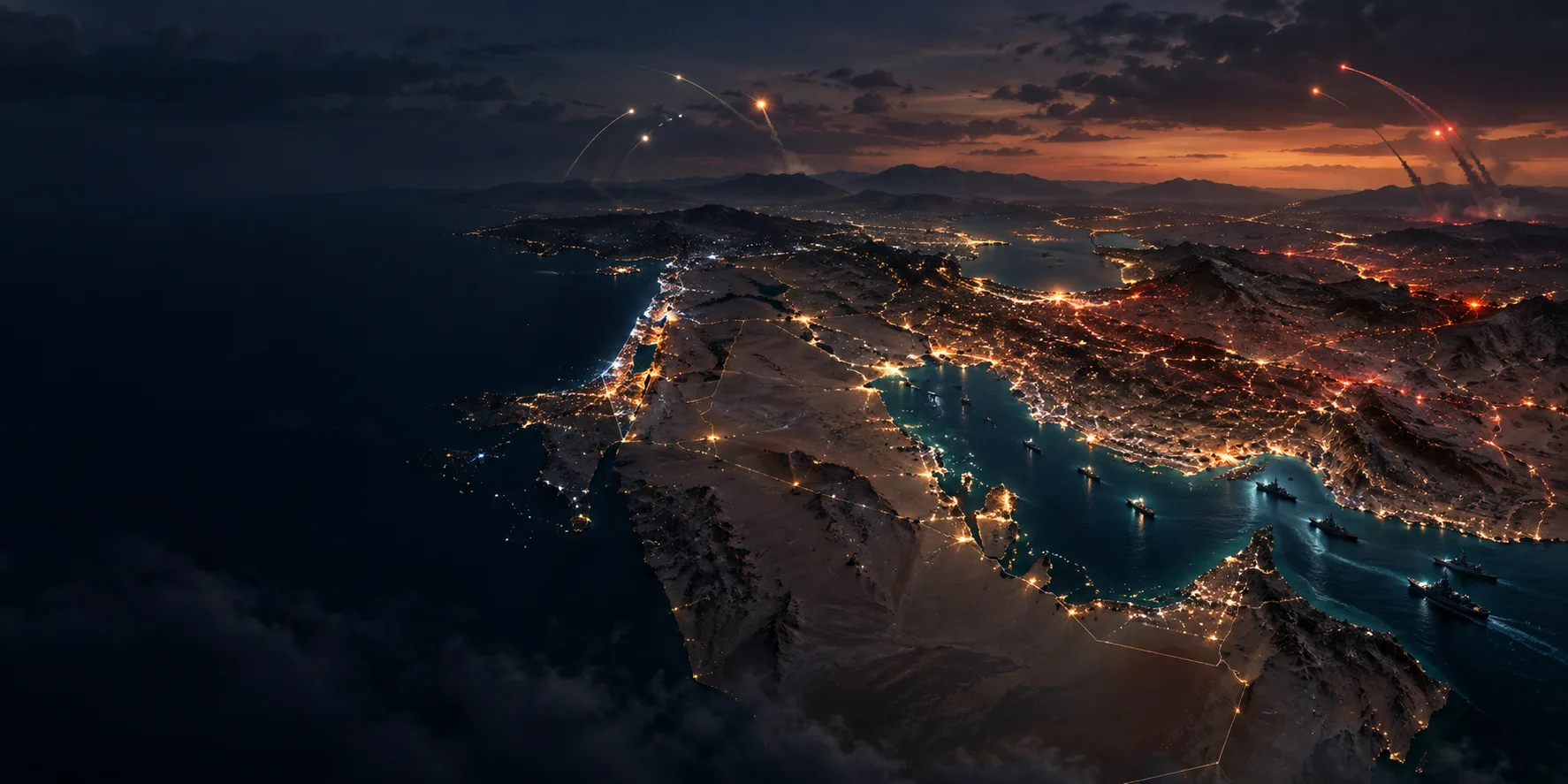
The conflict is intermittent. Its effects are constant.
The latest phase began when the United States and Israel attacked Iran on February 28, 2026. Iran answered with missiles and drones aimed at Israel, American forces, and regional states hosting U.S. bases. A June interim understanding reduced direct fire without resolving the nuclear program, maritime access, sanctions, or the role of Israel.
September opened with the largest exchange since July. Military targets, oil tankers, shipping lanes and financial networks became parts of the same pressure campaign. That matters globally: reduced traffic through Hormuz raises fuel, transport and food costs far from the battlefield.
Iranian, Israeli, Arab and American civilians bear real fear, injury, displacement and loss. Every analysis on this page begins with their human dignity.
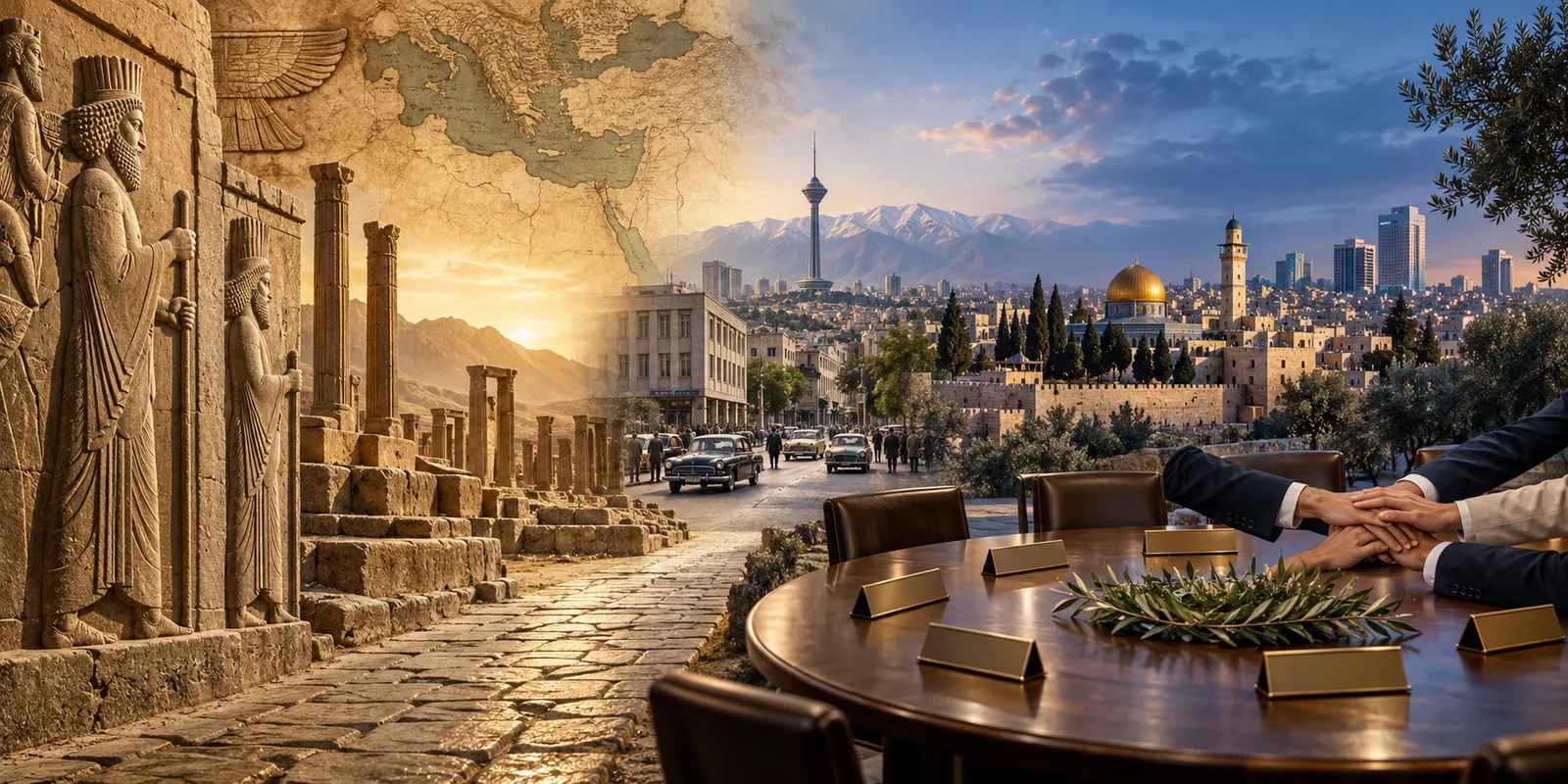
The relationship was not always hostile.
Ancient biblical history, the Shah’s quiet partnership with Israel, the 1979 revolution and today’s proxy networks belong to one complicated story.
Seven turning points
Persia appears throughout Scripture
Persian rulers were not portrayed only as enemies. Cyrus permitted Jewish exiles to return and rebuild the temple; Esther records Jewish life inside the empire.
Quiet strategic partners
Under the Shah, Iran and Israel maintained extensive but discreet economic and security ties, driven partly by shared concern about hostile regional powers.
The Islamic Revolution reverses the relationship
The new revolutionary state rejected the Shah’s Western alignment, embraced the Palestinian cause, and transformed Israel from a partner into an ideological enemy.
The shadow-war era
Iran built relationships with Hezbollah, Palestinian armed groups and other partners; Israel countered with intelligence operations, interdictions and strikes against weapons transfers and nuclear-linked targets.
The Abraham Accords reshape the region
The UAE and Bahrain normalized relations with Israel, followed by arrangements involving Morocco and Sudan. Cooperation expanded around trade, technology and security while the Palestinian conflict remained unresolved.
Direct fire replaces deniable confrontation
Iran and Israel exchanged direct drone and missile attacks. Israeli and American strikes against Iranian nuclear and military sites widened a conflict that had long been fought through proxies and covert action.
Open, intermittent regional war
The United States and Israel attacked Iran on February 28. Iran retaliated against Israel, U.S. forces and neighboring states hosting American bases; energy routes and allied armed groups pulled the effects far beyond Iran.
Normalization created a new regional alignment.
Signed beginning in September 2020, the agreements normalized Israel’s relations with the United Arab Emirates and Bahrain, with subsequent arrangements involving Morocco and Sudan. Their stated goals included peace, diplomatic relations, commerce, innovation, religious tolerance and regional cooperation.
Open diplomacy, flights, trade and security coordination made cooperation with Israel public instead of largely hidden.
Shared concern about Iran’s missiles, nuclear activity and armed partners helped drive practical alignment among Israel and several Arab governments.
Normalization did not resolve Palestinian statehood, Gaza, the West Bank, Jerusalem or deep public disagreement across the Arab world.
In September 2026, postwar planning again included possible expansion of normalization. That could strengthen a regional counterweight to Iran—but war can also make public cooperation with Israel politically harder.
Read the official Abraham Accords documentsFour conflicts overlap
Nuclear risk
Israel treats the possibility of an Iranian nuclear weapon as an existential threat; Iran says its nuclear program is peaceful.
Missiles and drones
Iran’s long-range arsenal and Israel’s layered air defenses make distance less protective than it once was.
Regional armed groups
Hezbollah, the Houthis and Palestinian factions connect Israel’s separate fronts to Iranian finance, weapons and strategy—with different degrees of control.
Regional order
The Abraham Accords, U.S. bases, Gulf monarchies, oil routes and Palestinian politics make bilateral fighting a region-wide contest.
Eight developments to understand
Summaries are based on linked reporting and current through September 10.
The monthlong lull broke
The United States struck IRGC air-defense, radar, maritime, mine-laying and communications targets. Iran answered with missiles and drones against U.S. sites around the region; Jordan said it intercepted missiles crossing its airspace.
Read sourcePressure became military and economic
The administration paired intermittent strikes with a new economic campaign. Diplomacy remained stalled over the original Israel–Iran trigger, nuclear questions, shipping access and compensation demands.
Read sourceThe definition of “war” became political
U.S. leaders publicly disputed whether to call the six-month conflict a war even as combat continued, military families sought benefits, and Washington announced new financial sanctions tied to Iran.
Read sourceThe fight moved deeper into oil shipping
U.S. forces struck three Iranian oil tankers after reporting ballistic-missile attempts against American warships. No U.S. personnel were reported hurt, but analysts described the exchange as a significant escalation.
Read sourceIran advertised a preemptive missile doctrine
Iranian state media presented an improved ballistic missile and said Tehran would act against threats before they were carried out. Independent confirmation of some performance claims remained limited.
Read sourceEnergy pressure reached global markets
Brent crude approached $100 as constrained Gulf flows and renewed attacks raised inflation concerns. Stocks fell as investors weighed higher transport, manufacturing and household energy costs.
Read sourceNuclear oversight returned to the Security Council
The IAEA board reported Iran to the U.N. Security Council over cooperation with an investigation into uranium traces at undeclared sites—the first such referral in two decades.
Read sourceHormuz and the Red Sea became one strategic picture
Iran-backed Houthis seized Yemen’s port city of Mokha, near the Bab el-Mandeb. The route grew still more important while the Iran war impeded shipping through the Strait of Hormuz.
Read sourcePersia matters—but humility matters too.
“Persia, Ethiopia, and Libya with them; all of them with shield and helmet.” Ezekiel 38:5 (KJV)
Modern Iran occupies the heartland of ancient Persia, so Bible readers naturally notice Ezekiel 38. That geographic connection is real. It does not prove that every modern strike is the final fulfillment of Ezekiel’s vision, nor does the passage authorize hostility toward Iranian people.
Scripture also remembers Persia through Cyrus, whom God used to release exiles and support the rebuilding of Jerusalem. The biblical picture is larger than “Iran equals enemy.” Our posture should be watchful, careful, prayerful and resistant to date-setting.
A prayer for everyone under fire
Lord of mercy, protect civilians in Iran, Israel and every neighboring land. Comfort those who mourn, heal the wounded, guard soldiers and emergency workers, restrain leaders from reckless escalation, expose falsehood, open paths to just peace, and strengthen Your church to serve courageously without hatred or fear. Give us wisdom to watch carefully and hearts that never become numb to suffering. In Jesus’ name, amen.